Region
Hydrogen Region Ruhr
Established hub for energy and future technologies
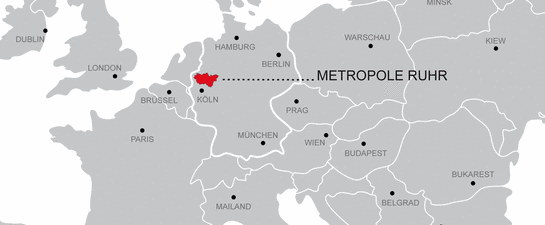
With its 5.3 million inhabitants, the Ruhr Metropolis is a technological, economic, scientific and cultural centre at the heart of Europe. Global corporations as well as innovative start-ups invest here in competition for leading positions at national and international level. Through the interplay of high-performing universities and leading scientific research institutes, innovations for the future are being created in the Ruhr Metropolis.
Chemical and hydrogen region with a tradition
Once the continent’s industrial heartland and still Europe’s number one energy region, the Ruhr Metropolis is increasingly becoming a centre for future technologies. Competence in hydrogen did not only emerge here with the energy transition; as a major chemical hub, the region can build on around 100 years of tradition in hydrogen. Now the task is to leverage this expertise to secure a leading industrial position in the storage of renewable energy, hydrogen logistics, and the wide-ranging use of hydrogen and fuel cells in transport, industry and decentralised energy supply.
Need for emissions reduction
However, the Ruhr Metropolis is also one of Europe’s largest conurbations and is therefore ideally suited for the early introduction of electric vehicles into the mass market. This also applies to hydrogen fuel-cell vehicles, which—thanks to high efficiency and operational flexibility, short refuelling times and long ranges—enable 100% renewable mobility based on stored energy. Conurbations like ours allow filling stations to achieve good utilisation quickly, and the existing hydrogen infrastructures, combined with the expertise of our skilled workforce, support their efficient supply.
Hydrogen and fuel cell activity
Initial developments and demonstration projects began as early as the turn of the millennium. In 2003, the Center for Fuel Cell Technology was founded in Duisburg. Later, within the Euwak project, the Emschergenossenschaft produced hydrogen from sewage gas. In the HyChain project, small vehicles were demonstrated whose electric drive systems were not yet satisfactory, but whose fuel cells reliably supplied energy. There were company start-ups (IdaTech, Masterflex, Hypower…), major initiatives (Blue Tower), the successful establishment of Hydrogenics GmbH in Gladbeck, the construction of the Hydrogen User Centre with wind-power electrolysis in Herten, the start of research and development at Westphalian University of Applied Sciences, and much more. In the meantime, a remarkable mix of research activities, demonstration projects and applications—up to and including the development and manufacture of market-ready products—has become established in the Ruhr metropolitan region.
Jobs
We aim to strengthen and further develop these approaches. Due to its key role in the energy transition, hydrogen and fuel cell technology will generate significant value creation over the coming decades and create and safeguard jobs. The Ruhr Metropolis should benefit from this.
