
Hydrogen was the main topic at the Emscher-Lippe Summit
North Rhine-Westphalia’s Prime Minister Armin Laschet highlighted the importance of hydrogen technology for the energy transition and pledged to support the Emscher-Lippe region’s efforts in this economic field.
More than two hundred stakeholders from business, politics, administration, and associations spent two days at the Westphalian University of Applied Sciences in Gelsenkirchen discussing the future of the Emscher-Lippe region. The region in the northern Ruhr area consists of the independent cities of Gelsenkirchen and Bottrop and the ten towns of the Recklinghausen district. This is where coal was mined for the longest time, and unemployment here is still higher than the state average and other parts of the Ruhr area.
Prime Minister Laschet sees H2 expertise in the region as an opportunity
District President Dorothee Feller had invited participants to the conference, and numerous representatives from regionally active companies and associations accepted her invitation. On the first day of the conference, Prime Minister Armin Laschet also addressed the participants and pledged his firm support for structural change in the Emscher-Lippe region. Laschet regards the expertise in hydrogen and fuel cell technology already present in the Emscher-Lippe region as a major opportunity for the region’s economic development.
On Thursday, October 10, 2019, the second day of the conference, three workshops focused on the topics of “Hydrogen,” “Talent Promotion,” and “Economy and Urban Development.” The “Hydrogen” workshop attracted by far the greatest interest from participants: more than two-thirds discussed opportunities, risks, and the necessary next steps with industry representatives and scientists.
Production costs for green hydrogen must fall
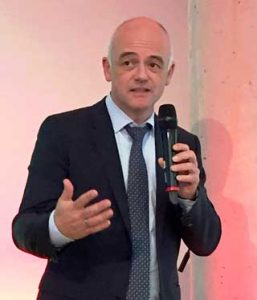
One of the first speakers was Noé van Hulst, the Hydrogen Envoy of the Dutch Ministry of Economic Affairs. He expressed the view that—following the use of “blue hydrogen” in a transition phase—green hydrogen is essential for the energy transition. The most important areas of application are industrial applications, heavy-duty transport (including shipping in addition to trucks and buses), and long-term energy storage. While the production costs for green hydrogen in Europe are currently still far too high to make it a competitive energy source, van Hulst sees a great opportunity in the production of solar power in Australia, South Africa, Chile, Saudi Arabia, and other sun- or wind-rich countries to generate inexpensive hydrogen there through electrolysis and export it by tanker or pipeline. From Australia, he brought back a fitting quote from a minister: “We will ship sunshine around the world.”
The Dutchman also sees a need for further expansion of renewable energy production in Europe. In his view, the North Sea offers a potential of 100 to 150 gigawatts from offshore wind power.
Using natural gas pipelines for H2 transport
The Netherlands’ plans to use redundant natural gas pipelines to transport hydrogen, which will be produced in the future using large electrolyzers, are also being pursued by the major German gas network operators. Both Open Grid Europe and Thyssengas presented corresponding plans at the conference and announced applications for federal funding for their investments.
Speakers and discussion participants agreed that the necessary investments for the expansion of hydrogen technology must be initiated now and in the next one to two years in order to be able to compete in the top tier by 2030.
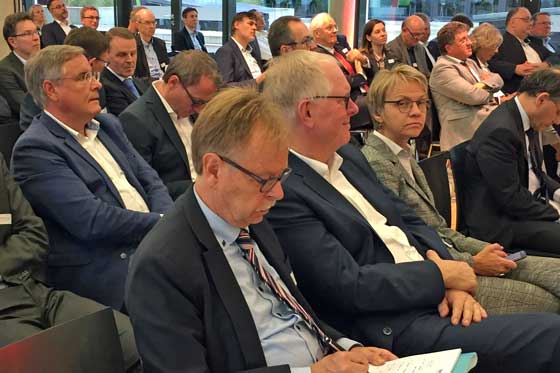
Cover photo: District President Dorothee Feller (3rd from left in the front row) and District Administrator Cay Süberkrüb (2nd from left) also followed the presentations and discussions on hydrogen technology; next to them sits Volker Lindner, Chairman of h2-netzwerk-ruhr e.V., who moderated the hydrogen workshop.