
Exciting presentations and lively discussions
Advisory Board of h2-netzwerk-ruhr meets at the Chamber of Industry and Commerce in Gelsenkirchen
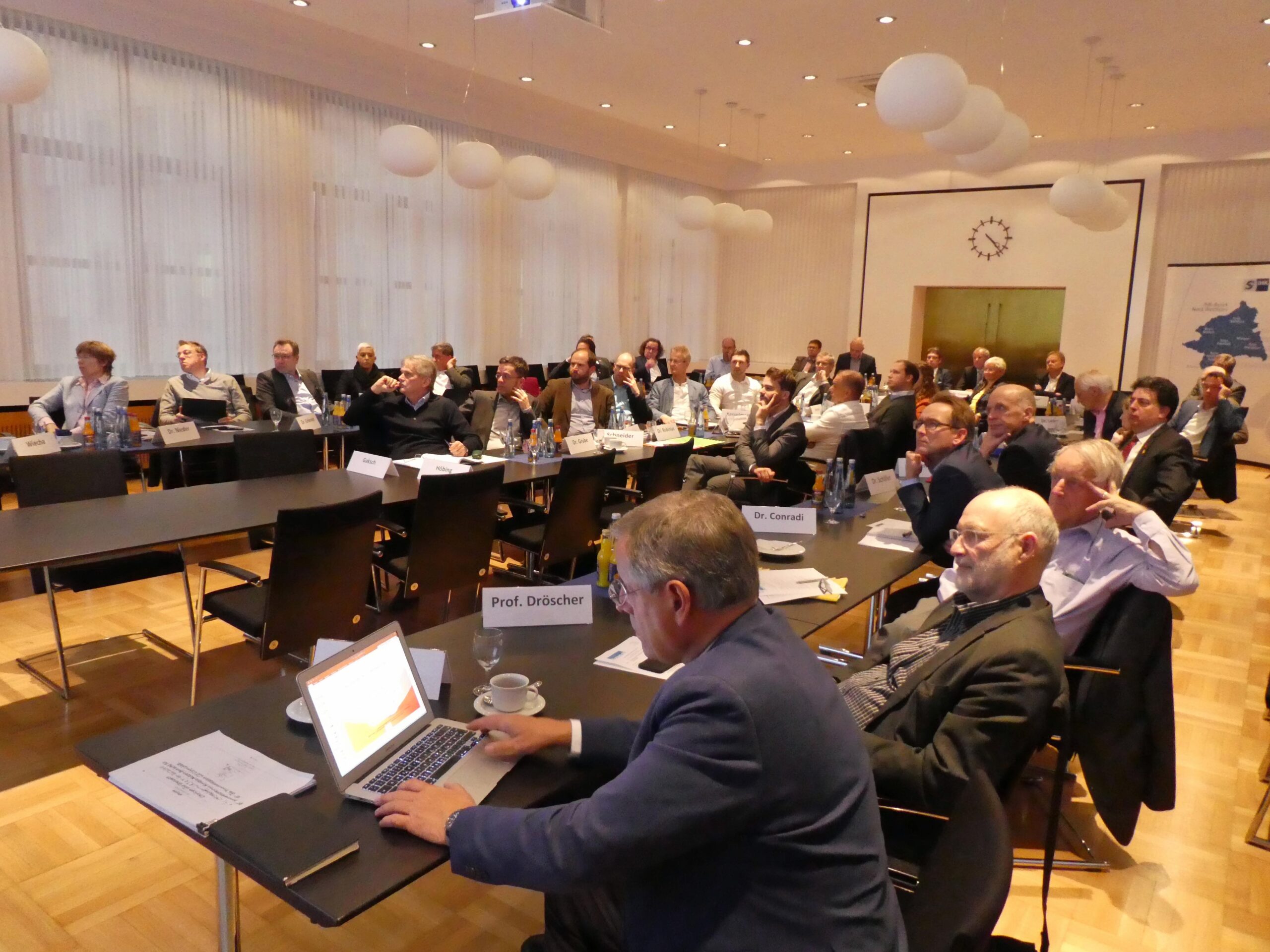
On November 25, 2019, more than 40 representatives from companies, research institutions, associations and municipalities who are members of the h2-netzwerk-ruhr Advisory Board met in the large conference room of the IHK Nord Westfalen in Gelsenkirchen. They had accepted the invitation of Dr Bernd Emonts, Scientific Coordinator of the Institute of Energy and Climate Research at Forschungszentrum Jülich, who serves as Chair of the Advisory Board.
In total, participants listened to ten presentations during the seven-hour event. And in virtually all contributions it became clear: the energy transition will not work without hydrogen. And green hydrogen will not work without a massive expansion of renewable energies – especially wind power.
Forschungszentrum Jülich presented the results of a system analysis on the “Energy future with hydrogen” and a “Large-scale RES simulation using wind as an example”, both of which met with great interest among those present.
The studies by Forschungszentrum Jülich describe how the official goal of reducing greenhouse gas emissions by 95 percent by 2050 can be achieved. It becomes clear that large quantities of renewable energy must be made available, not only in the form of electricity, but also as hydrogen produced from green electricity. In particular, there is still significant wind power potential to be developed in northern Germany. The costs of electricity generated onshore are the lowest, followed by electricity produced offshore. Energy imported in the form of hydrogen from sunny and windy countries is more expensive. However, the studies also make it clear that the climate targets of Central European industrialised countries cannot be achieved without importing green energy. The costs of the transformation of our energy system outlined in this way are enormous, but almost equally large expenditures for the currently still necessary imports of crude oil, natural gas and coal will be eliminated. A far larger share of value creation remains in the country, and the export of innovations developed in Germany creates thousands of new jobs.
In his conclusion, the Chair of h2-netzwerk-ruhr, Volker Lindner, stated: “The course must be set now for an accelerated energy transition. Only then can the climate catastrophe be averted and the economic opportunities be seized.” Lindner sees potential particularly for the Ruhr Metropolis: “We must take the lead here in order to initiate the energy transition in industry as well.”
In the coming weeks, h2-netzwerk-ruhr will publish summaries of some of the presentations here.
Title photo: Numerous company representatives followed the expert presentations with great focus.