Hydrogen Roadmap Emscher-Lippe presented
Participation of h2-netzwerk-ruhr
Eighteen months of planning and more than 40 projects: A broad alliance of politics, business and academia has now presented a concrete roadmap for the Emscher-Lippe hydrogen region – a new decade-long project that is to be implemented by 2030 with an investment volume of around 1 billion euros. The aim of the H2EL Roadmap is to safeguard the region’s industrial base and create new jobs. “After the blue sky over the Ruhr, green industry is now coming to the Emscher and Lippe,” says District Administrator Bodo Klimpel, Chair of the Executive Board of WiN Emscher-Lippe GmbH. WiN Emscher-Lippe GmbH is a member of h2-netzwerk-ruhr, and numerous other members of h2-netzwerk-ruhr e.V. are also part of the Roadmap, including the hydrogen user centre h2herten, AGR, Westfälische Hochschule and Emschergenossenschaft / Lippeverband (EGLV).
The region is pursuing a pragmatic approach: “We are using the existing resources and expertise to build a hydrogen economy faster and more cost-effectively than other regions,” said Bodo Klimpel. Ernst & Young thus attests the Emscher-Lippe region has “excellent prerequisites” for establishing itself as an H2 model region, provided a closely coordinated strategic concept is pursued.
“The H2EL Roadmap shows the way to climate neutrality with green hydrogen and, at the same time, will lead to a new quality of life through supply concepts for neighbourhoods and new mobility,” said Gelsenkirchen’s Lord Mayor Karin Welge, Deputy Chair of the Executive Board of WiN Emscher-Lippe GmbH. “The pioneering role of industry can pave the way for business relocations and make the consistent use of green hydrogen technologies an export hit from the northern Ruhr area. The transformation continues,” said the Lord Mayor. As an outstanding example, Welge cited the “Climate Port Gelsenkirchen”, where SMEs, inland shipping and large-scale industry are to be gradually converted to climate neutrality in a joint project.
Decade-long project as a major undertaking for the region
At the presentation, those involved emphasised that implementing the Roadmap by 2030 would be a major undertaking for the region : “The goal of climate neutrality poses enormous challenges for industry,” explained Lars Baumgürtel, Vice President of the IHK North Westphalia. To master the transformation, SMEs as well as large-scale industry must have access to green hydrogen. “If we tackle this together now and implement projects with combined efforts, the Emscher-Lippe region can build on proven strengths of the Ruhr Metropolis and become a hydrogen model region,” said Baumgürtel, who in his company ZINQ GmbH & Co. KG has already invested heavily in climate-friendly technology .
Ambitious targets for hydrogen mobility
The Roadmap also sets ambitious targets for mobility: “We want to increase the share of renewable energies in the transport sector, which is currently still 7.3% nationwide, to 30% in our region by 2030,” said Bernd Tischler, Lord Mayor of the City of Bottrop and Deputy Chair of the Executive Board of WiN Emscher-Lippe GmbH. In 2030, 1,000 trucks, 120 buses and 100 refuse collection vehicles are to be powered by fuel cells and at least one hydrogen refuelling station is to be available in every city. “To this end, we will apply for further funding from the Federal Ministry of Transport (HyPerformer).”
Infrastructure as a key building block for a green industrial region
Regional President Dorothee Feller gave an outlook on the next steps. The key building block on the path to a green industrial region is the use and expansion of infrastructure: even now, Germany’s longest hydrogen pipeline originates in the Emscher-Lippe region. The federally funded GET H2 project will create a publicly accessible network that supplies industry with green hydrogen from the Emsland and, in the longer term, connects the Emscher-Lippe hydrogen region with the North Sea ports of Rotterdam, Antwerp and Wilhelmshaven and with the Rhineland. “If we want to use hydrogen to preserve jobs in energy-intensive industries, create new jobs and achieve climate targets, we must not think in terms of regions alone. It will be crucial to overcome national and regional borders along value chains and connect cooperatively. As Regional President, I also see it as my task to support this transformation and initiate networking,” said Dorothee Feller.
Hydrogen Summit and roadshow in autumn
The perspectives are to be further developed and specified on 4 October at the former Fürst Leopold hard coal mine in Dorsten at the Hydrogen Summit, to which the Regional President is inviting participants. On the way there, there will be the opportunity to get to know specific projects as part of a roadshow, for example on 14 September at the chemical park in Marl.
For project-related enquiries: Hydrogen coordinators Emscher-Lippe:
Dr Babette Nieder
0172 8027004
02366 1 098-38
babette.nieder@emscher-lippe.de
Dr Klaus Rammert-Bentlage
0157 83022126
02366 1 098-31
klaus.rammert-bentlage@emscher-lippe.de
Press contact:
Stefan Prott
RDN Agency for Public Relations GmbH & Co. KG
0172 4258582
02361 490491-1 0
s.prott@rdn-online.de
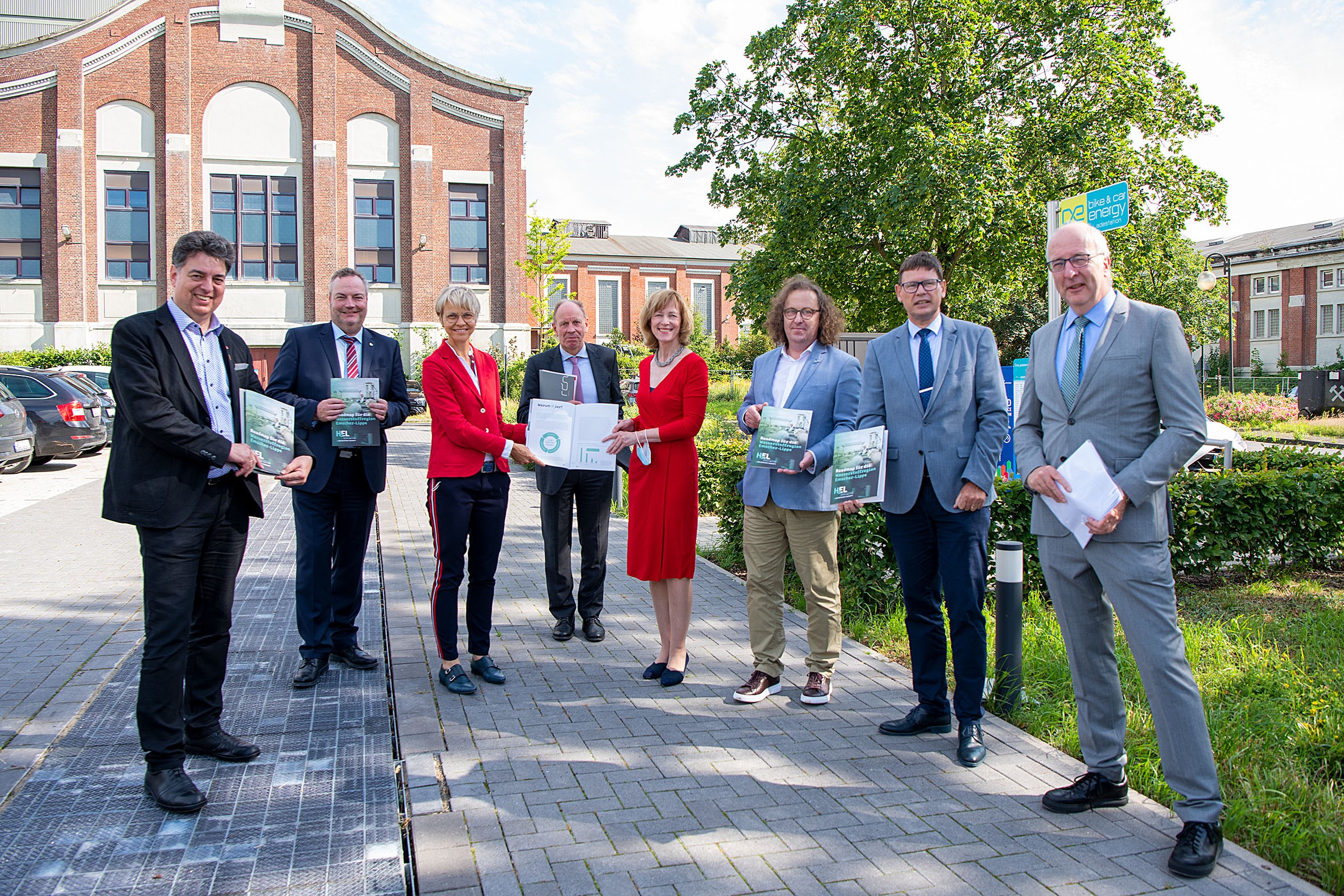
Title photo: They presented the Roadmap for the Emscher-Lippe hydrogen region: Dorothee Feller, Regional President of Münster (3rd from left), with the Executive Board of WiN Emscher-Lippe GmbH (from left): Mark Rosendahl, Managing Director of DGB Region Emscher-Lippe, Bodo Klimpel, District Administrator of the Recklinghausen district, Bernd Tischler, Lord Mayor of Bottrop, Karin Welge, Lord Mayor of Gelsenkirchen, Lars Baumgürtel, Vice President of the IHK North Westphalia, Dr Jochen Grütters, Deputy Chief Executive Officer of the IHK North Westphalia, and Thomas Harten, Managing Director of the Münster Chamber of Crafts. Photo: RDN/Beushausen