Is waste the coal of the future?
The Advisory Board of h2-netzwerk-ruhr examines the “color spectrum” of hydrogen
On Friday, May 20, 2022, the Scientific Advisory Board of h2-netzwerk-ruhr e.V. met at the offices of Gelsenwasser AG in Gelsenkirchen. Chaired by Dr. Bernd Emonts (Forschungszentrum Jülich), the more than thirty participants addressed the so-called “color spectrum” of hydrogen, referring to its origin.
All experts agree that the majority of hydrogen, an energy carrier that will become increasingly important in the future, will be produced by electrolysis using renewable energies, making it “green.” However, this does not mean that there will not also be alternative production methods that may have their justification beyond just the transition period.
Expert presentations and lively discussions
But first things first: Following the welcome by Dr. Arnt Baer, who heads the Politics and Associations department at Gelsenwasser, and Dr. Bernd Emonts, Prof. Dr. Jochen Linssen from FZ Jülich provided an overview of the roadmap to climate neutrality by 2045 and the key role hydrogen plays in it. Subsequently, Karsten Opitz from Graforce GmbH promoted “plasmalysis” as a method for extracting “turquoise” hydrogen and solid carbon from methane, wastewater, and residual materials. He emphasized the lower electricity requirement compared to water electrolysis, as well as the usability of the captured carbon as a raw material for industry. A similar process was the focus of the presentation by Robert Bock, Plagazi AB: “Green Hydrogen from waste”. This plant technology is initially intended to use plastics that are absolutely non-recyclable.
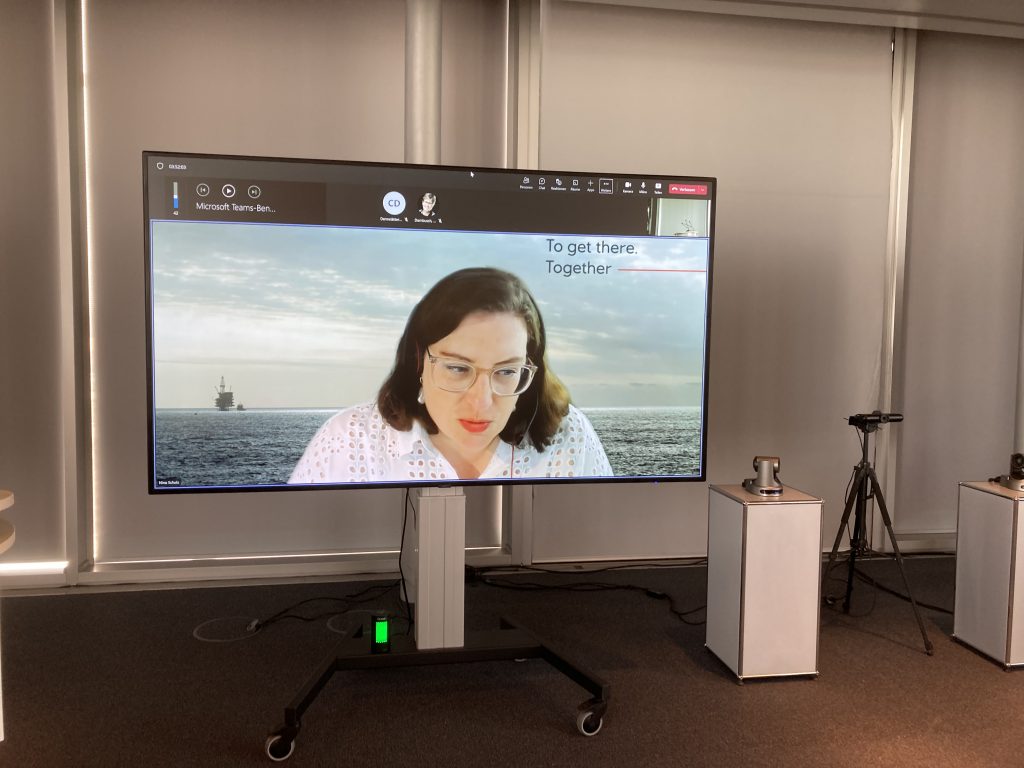
Nina Scholz from Equinor Germany joined the advisory board meeting digitally 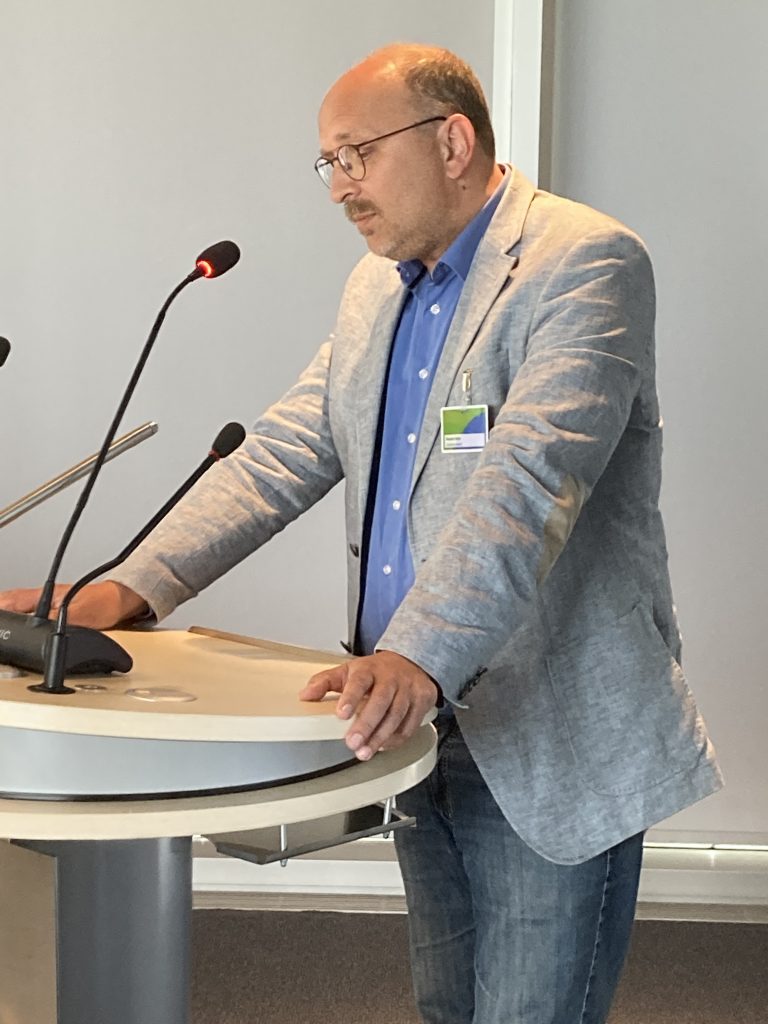
Karsten Opitz, Graforce GmbH, aims to use significantly less energy for H2 production with his process 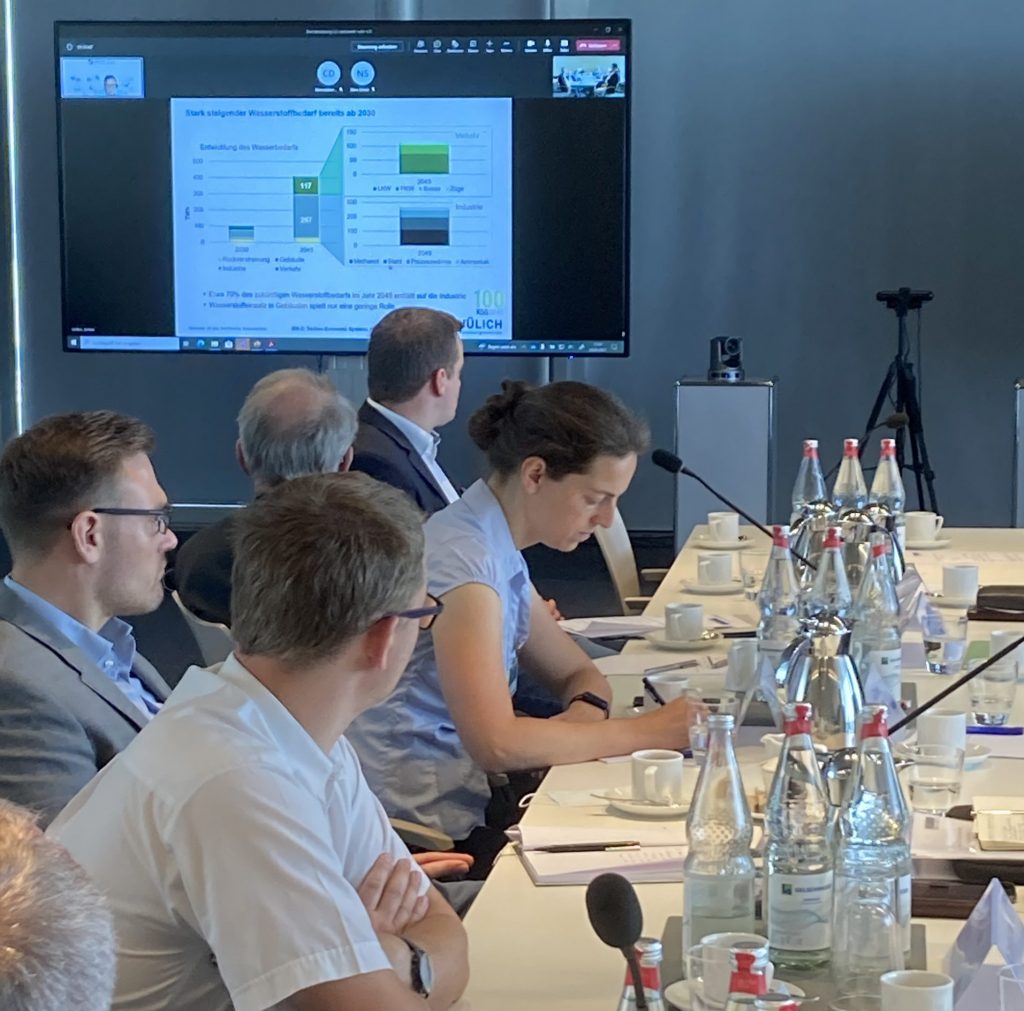
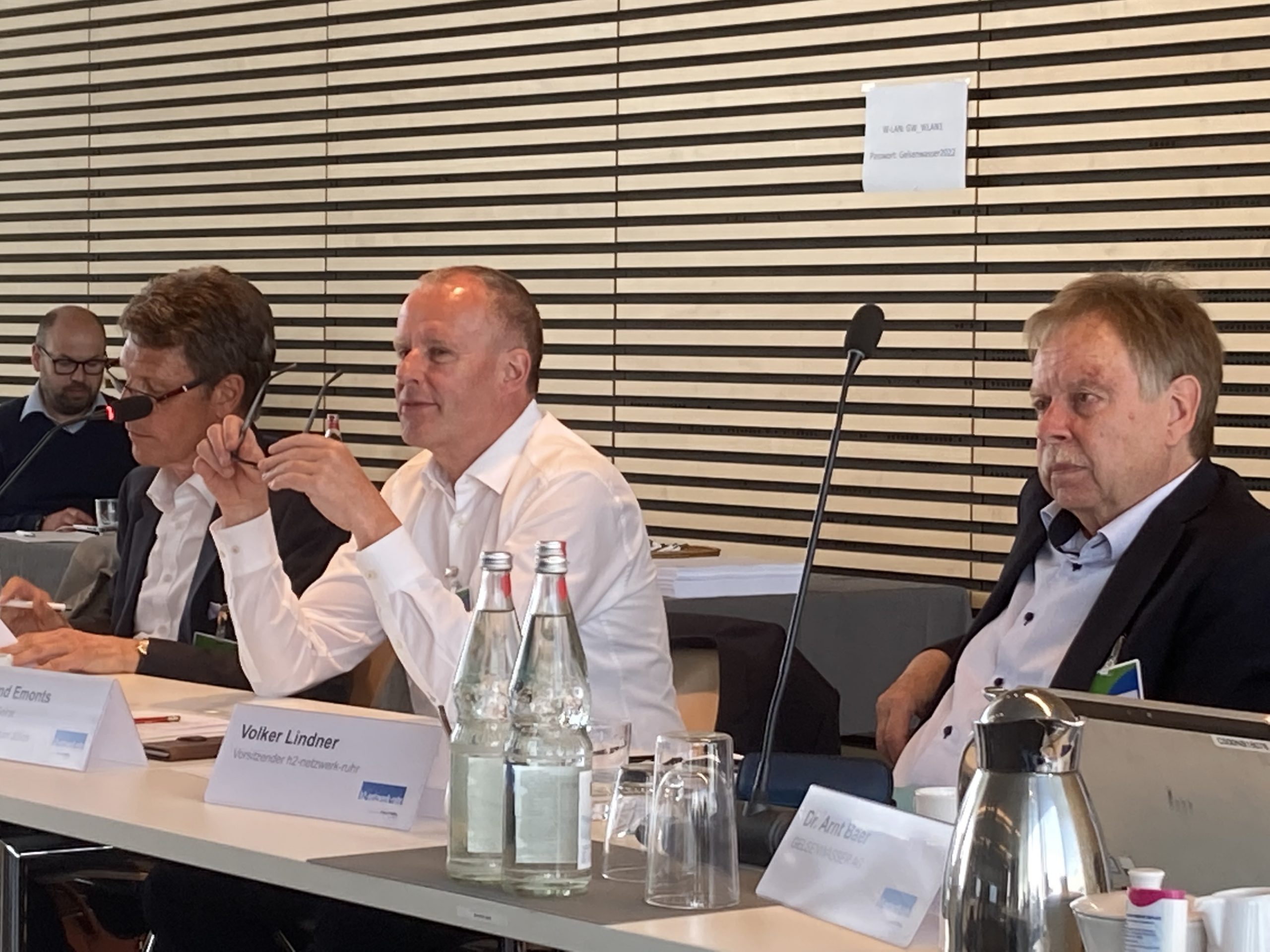
More than thirty participants followed the presentations on the “color spectrum” of hydrogen with great interest. 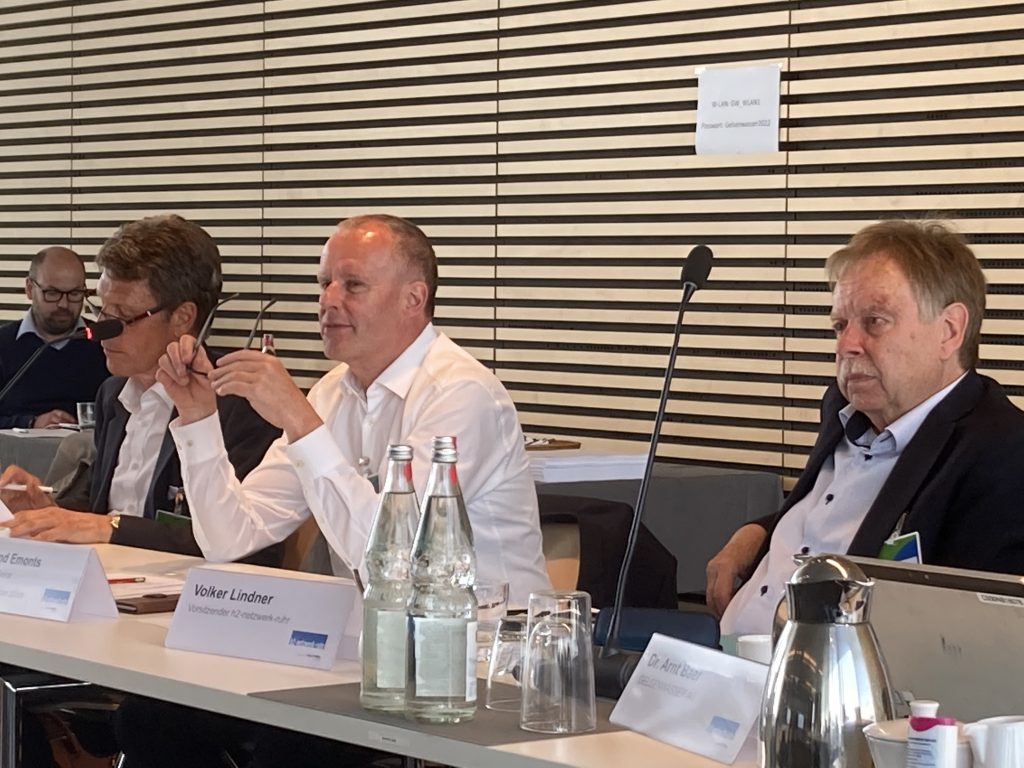
Volker Lindner and Bernd Emonts (from right to left)
Prof. Elmar Brügging from the Münster University of Applied Sciences addressed the challenges in the production, distribution, and storage of “green” hydrogen on an industrial scale, before Nina Scholz from Equinor Germany described “blue” hydrogen as a perspective for climate-friendly H2 on an industrial scale. Equinor will produce “blue hydrogen” from natural gas and, according to its own statements, safely store the captured CO2 in deeper rock layers in Norway. However, the currently high natural gas prices and the demand for conventional uses currently pose a problem.
All presentations were followed by interested, and sometimes controversial, questions and discussions, so that meeting chair Bernd Emonts repeatedly had to check the time and urge speakers to limit their speaking time.
Conclusion: More speed for renewable energies
In conclusion, it can be stated: The expansion of renewable energies must be pushed forward at high speed. The legal framework at national and European levels is not yet sufficiently oriented toward a hydrogen economy. Furthermore: Until “green” hydrogen is available in sufficient quantities, doing without “grey” and “blue” hydrogen is neither possible nor sensible. And with plasma processes, hydrogen can be extracted from many residual materials in the future, which led Dr. Bernd Emonts to the final observation: “Waste is the coal of the future”.