The Future of the Region Lies in Hydrogen
Member of the Bundestag Irene Mihalic Visits h2-netzwerk-ruhr
Together with representatives of the DGB and the IHK, Volker Lindner welcomed Member of the Bundestag Dr. Irene Mihalic on September 8, 2021, at the H2Herten Application Center. Although Ms. Mihalic is primarily engaged in domestic policy, the economic future of the Ruhr region is particularly close to her heart. “As a Gelsenkirchen native, I naturally want to know where the future of our region lies.”
The topic of hydrogen and its significance for the energy transition and climate protection was not new to her. “Hydrogen will have its greatest impact on climate protection when deployed in industry,” she explained, and met with this statement with unanimous approval from network chairman Volker Lindner, Lars Baumgürtel, Vice President of the Chamber of Industry and Commerce (IHK) Nord Westfalen, and Dr. Jochen Grütters, Deputy Managing Director of IHK Nord Westfalen and Head of the IHK Emscher-Lippe location. Baumgürtel emphasized that particularly the market for industrial process heat, which is responsible for 126 million tons of CO2 annually, must become carbon-free. This will only be achieved through the large-scale deployment of hydrogen.
Volker Lindner drew attention to the fact that there is above all a lack of sufficient quantities of renewable electricity. The future federal government must massively accelerate the expansion of wind and solar energy. And from the year 2030 onwards, electrolysis capacities of 250 gigawatts annually will be needed. To this end, the h2-netzwerk-ruhr has initiated a project proposal for a research center for the further development of electrolysis technology. Under the title “Hydrogen Laboratory Ruhr,” industry together with partners from the university landscape will increase the efficiency of electrolysis.
Even with increased utilization of the wind and solar energy available in Germany, there will be no way around importing hydrogen in the long term. Sun-rich countries, for example in the Arab region, are already preparing to switch from oil and gas to hydrogen production.
It was important to Dr. Mihalic to point out that the energy transition also includes the other side of the coin: “We must also reduce energy consumption in Germany. The question is: How do we achieve more efficiency in the consumer market?”
Incidentally, vocational training also plays a crucial role in building a hydrogen-based economy. Here, Tobias Krupp from DGB Emscher-Lippe sees a key to the successful establishment of electrolysis and fuel cell technology. For Irene Mihalic, this should not be the last visit to h2-netzwerk-ruhr. She promised to return after the federal election with a bit more time and then also to view practical examples of hydrogen production and utilization.
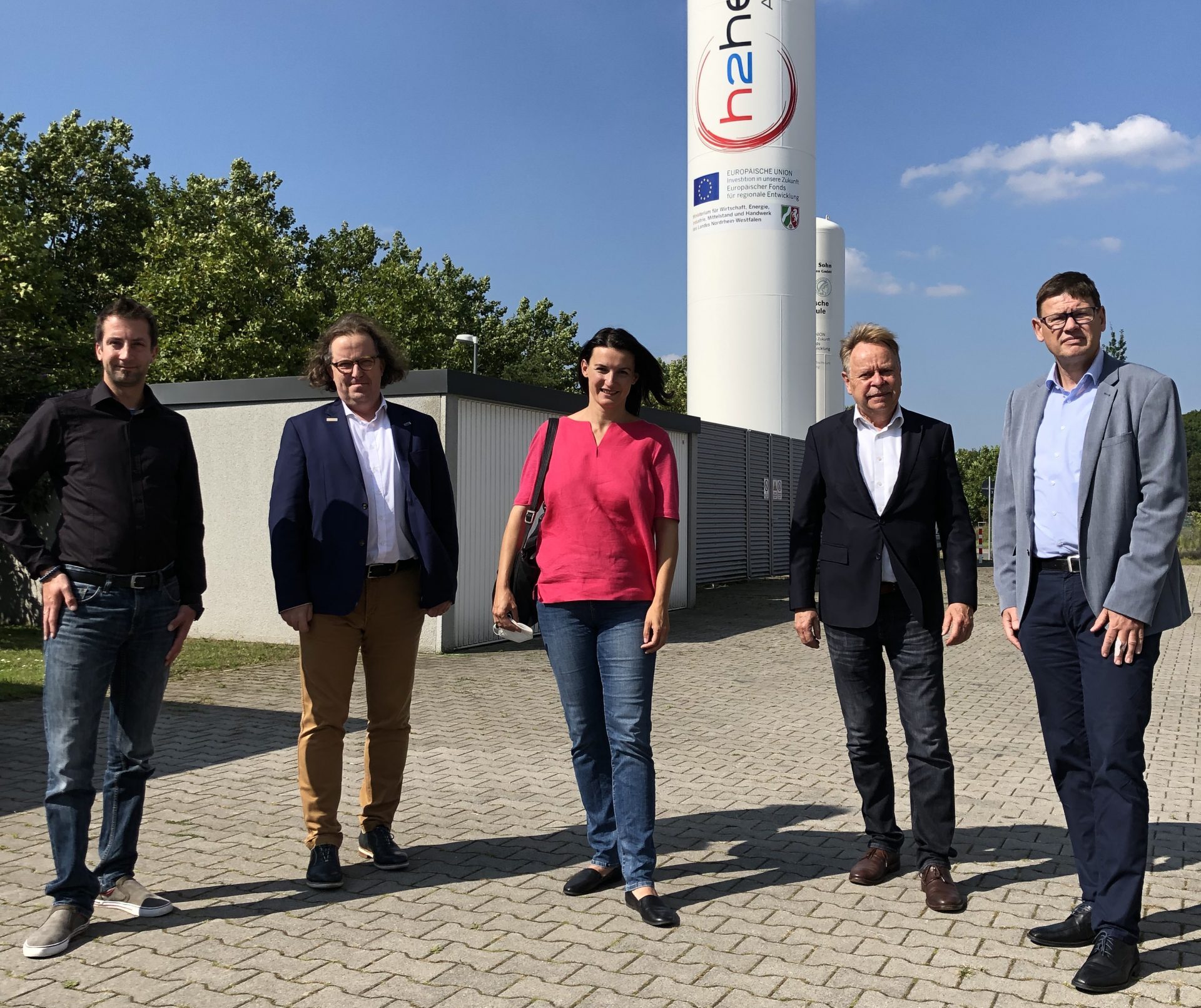
Title photo: In front of the hydrogen tank at the H2Herten Application Center (from left to right): Tobias Krupp (DGB), Lars Baumgürtel (ZINQ, IHK), Dr. Irene Mihalic MdB, Volker Lindner (h2-netzwerk-ruhr), and Dr. Jochen Grütters (IHK Nord Westfalen).