Online members’ evening is a success
Volker Lindner: “Fantastic participation – great presentations”
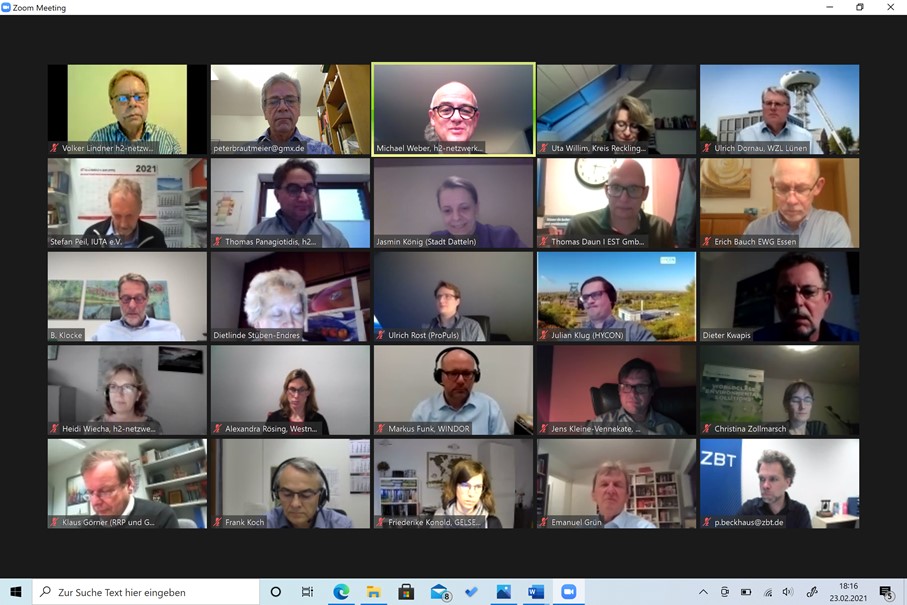
With a good fifty participants, the first digital members’ evening of h2-netzwerk-ruhr was the best-attended event of this kind to date. Due to the coronavirus pandemic, it was not possible to meet as usual at a member’s place of business. However, the Zoom conference held instead met with great interest among the members.
In the first part of the event, the members who had joined since January 2020 had the opportunity to introduce themselves in two- to three-minute statements. Afterwards, current member projects were presented in short talks. Using a new tool, participants were able to ask questions and rate the relevance of questions asked by others.
The number of short presentations does not allow a complete introduction at this point, so only a few are mentioned here:
Dr Erich Bauch presented the HyExperts project in Essen, which aims to make buses in local public transport completely emission-free by 2034, by using hydrogen.
Professor Klaus Görner from GWI presented the plans for an energy cockpit, developed as part of the Rhein Ruhr Power e.V. initiative. It is intended to become a cross-sector approach to sector coupling and, in the initial phase, to be implemented in a model region in the central Ruhr area. By using and further expanding the h2 pipeline network already in place here, the first step will be to connect the (potential) major hydrogen feed-in and off-take points (chemical industry) with each other.
Julian Klug from Hycon presented a project outline that forms the basis for a largely CO2-free waste management centre in the district of Gifhorn. An important finding from this project: With a 100% reduction in CO2 emissions, costs would be 50% higher than if a 90% reduction is targeted.
Dr Bernhard Klocke, Stadtwerke Haltern am See, presented the plans for a hydrogen-based, climate-neutral electricity and heat supply project for the planned Energy and Environmental Campus Haltern am See, which is to be built on the site of a former explosives factory (WASAG).
From Holzwickede, Alexandra Rösing of Westnetz reported on connecting end consumers to a hydrogen pipeline. This involves converting an existing natural gas pipeline. The project is intended to provide information on how suitable the existing natural gas infrastructure is for transporting hydrogen to end customers and what technical changes would be required. The event lasted three and a half hours. All the more astonishing that Volker Lindner still had more than thirty listeners for his closing remarks.
Photo: The digital members’ evening was a complete success. The image shows less than half of the participants.